


Krishna and Karna Conversation on Dharma

Updated: 2 days ago
KARNA, KRISHNA AND THE UNFAIRNESS OF LIFE
Life may or may not be fair.
But does fairness or unfairness determine Dharma?
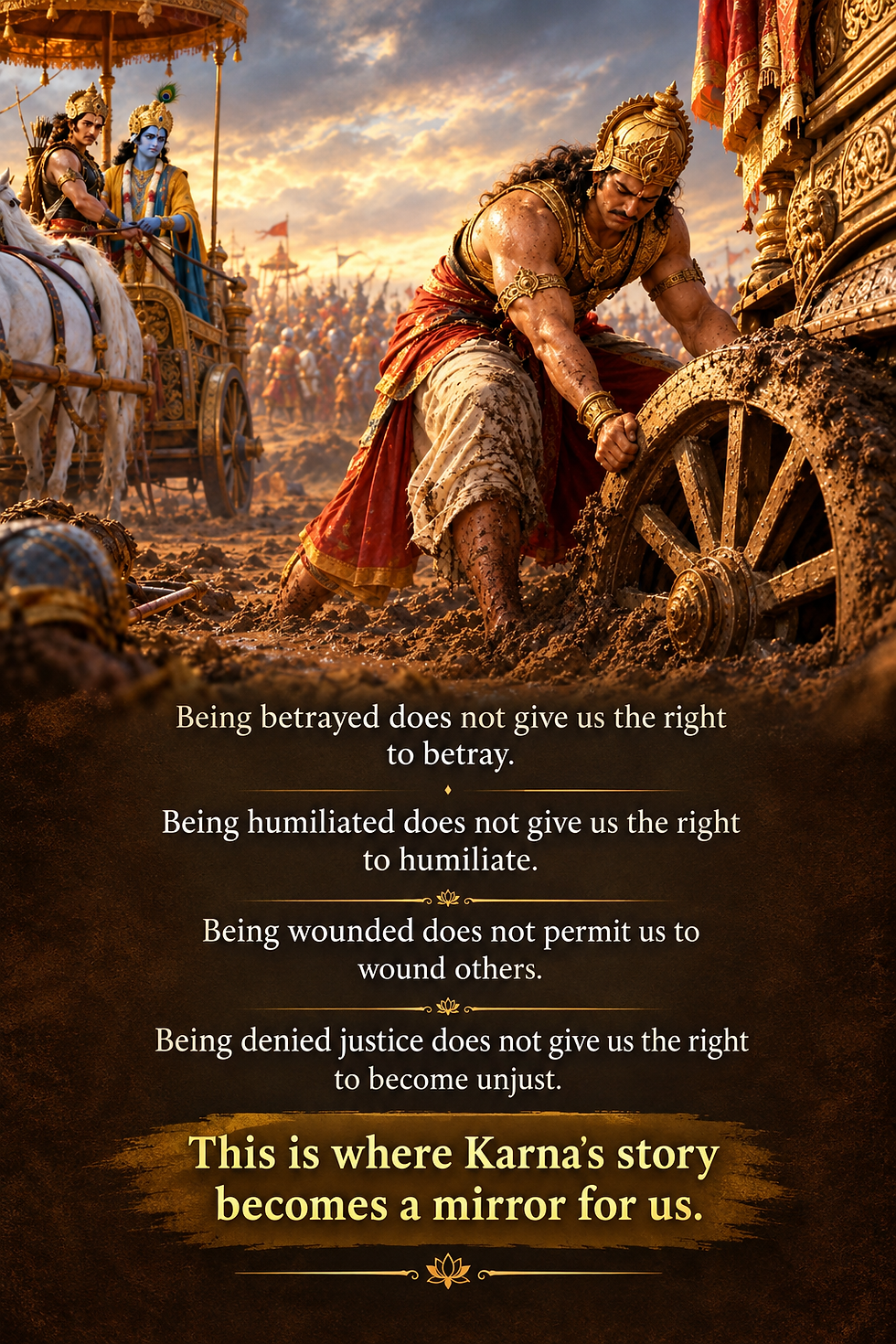
There is a popular anecdote attributed to Karna and Krishna.
Karna asks:
“Why am I wrong?”
My mother abandoned me at birth.
I was denied education because I was considered to be of a lower caste.
Parashurama cursed me when he discovered my identity.
I was cursed because an arrow accidentally killed a cow.
I was humiliated at Draupadi's Swayamvara.
Even my own mother revealed the truth about my birth only when she wanted to protect her other sons.
Whatever honour I received came only through Duryodhana.
So why should I not stand with him?
It is a powerful question.
But perhaps Karna's question is not really only Karna's question.
It is our question.
“WHY ME?”
How many times has the mind asked:
Why me?
Why was I born into these circumstances?
Why did this happen to me?
Why was I denied what others received?
Why was I betrayed?
Why was I humiliated?
Why did they hurt me?
Why does somebody else seem to receive everything effortlessly while I have to struggle for everything?
The human mind constantly compares its circumstances with those of others.
And from that comparison arises a story:
“Life has been unfair to me.”
Sometimes it may indeed appear unfair.
Sometimes it may genuinely be unfair.
But here is the deeper question:
Does the unfairness of life determine Dharma?
Does somebody else's action determine how I should act?
Does my suffering permit me to make another suffer?
Does humiliation justify humiliation?
Does injustice justify Adharma?
Does pain give the ego a license to become what it condemns?
No.
SUFFERING IS NOT DHARMA
Suffering can explain our pain.
It does not automatically justify our actions.
Being betrayed does not give us the right to betray.
Being humiliated does not give us the right to humiliate.
Being wounded does not permit us to wound others.
Being denied justice does not give us the right to become unjust.
Pain is real.
But pain is not Dharma.
This is where Karna's story becomes a mirror for us.
The question is not merely:
“What happened to me?”
The deeper question is:
“What did I become because of what happened to me?”
THE EGO LOVES ITS STORY
The mind remembers.
It remembers the insult.
It remembers the betrayal.
It remembers who failed us.
It remembers who rejected us.
It remembers what we deserved but did not receive.
And slowly, something happens.
The experience becomes an identity.
“I was abandoned.”
“I was rejected.”
“I was cheated.”
“I was humiliated.”
“I was not given what I deserved.”
Then the ego quietly adds:
“Therefore, I am justified.”
This is the trap.
The ego takes the wound and turns it into a reason to continue the wound.
It collects evidence.
It keeps score.
It compares.
It calculates.
It says:
“After everything they did to me, I have every right to do this.”
But Dharma does not operate according to the mathematics of revenge.
THE QUESTION CHANGES
The ordinary mind asks:
“Why is life unfair?”
The spiritual mind asks:
“How should I respond?”
But Jnana asks something even deeper:
“Who is the one to whom this is happening?”
This is the turning point.
The moment we ask:
“Who is this ‘me’?”
we have begun moving from the outer story to the inner enquiry.
WHO IS THIS “ME”?
“I was insulted.”
Who was insulted?
“I was betrayed.”
Who was betrayed?
“I suffered.”
Who suffered?
“I was successful.”
Who was successful?
“I failed.”
Who failed?
Every statement begins with “I.”
But what is this I?
Is it the body?
The body that existed in childhood is not the same body that exists today.
Is it the mind?
Thoughts continuously change.
Is it emotion?
Emotions arise and disappear.
Is it memory?
Memory itself changes and is sometimes forgotten.
Is it circumstance?
Circumstances constantly change.
Yet something knows the body.
Something knows the thoughts.
Something knows the emotions.
Something knows the memories.
Something knows success and failure.
Something knows pleasure and pain.
What is that something?
CIRCUMSTANCES ARE NOT THE SELF
This is where the wisdom of Self-enquiry begins.
The body is part of the story.
The mind is part of the story.
The circumstances are part of the story.
The relationships are part of the story.
The victories and defeats are part of the story.
The insults and honours are part of the story.
The birth and death of the body belong to the story.
But the Self is not another character inside the story.
The Self is That in which the entire story appears.
The story changes.
The Knower of the story does not.
LIFE MAY BE UNFAIR
Dharma is not a contract with life.
It does not say:
“If I behave correctly, nothing painful will happen to me.”
Life makes no such promise.
A righteous person can suffer.
An apparently unrighteous person can prosper.
A sincere person can be misunderstood.
A dishonest person can be praised.
A loving person can be abandoned.
A cruel person can be celebrated.
Therefore:
Do not measure Dharma by what you receive from life.
Measure it by the truth with which you live.
THE SHOES AND THE STEPS
There is a modern expression:
Destiny is not created by the shoes we wear, but by the steps we take.
The shoes represent circumstances.
The steps represent how we move through those circumstances.
Some begin barefoot.
Some begin with expensive shoes.
Some walk on smooth roads.
Some walk through thorns.
Some carry heavy burdens.
But the question remains:
Where are we walking?
We may not have chosen the shoes.
But we can enquire into the one who is walking.
And eventually, even that begins to dissolve.
FROM DOERSHIP TO SURRENDER
From the standpoint of the ego:
“I am walking through life.”
From the standpoint of Jnana:
Life is appearing in Consciousness.
The body moves.
The mind thinks.
Prarabdha unfolds.
Events happen.
Actions occur.
Experiences arise and disappear.
And the witnessing Presence remains untouched.
This does not mean becoming careless about Dharma.
Quite the opposite.
As identification with the ego loosens, action becomes less about:
“What do I get?”
and more about:
“What is to be done?”
Less personal calculation.
Less resentment.
Less demand for recognition.
Less insistence:
“My way or no way.”
And more surrender…
KARNA'S QUESTION BECOMES OUR ENQUIRY
Perhaps the most important lesson is not:
“What should Karna have done?”
The deeper question is:
“What am I doing with my own suffering?”
Am I carrying it?
Am I protecting it?
Am I building an identity around it?
Am I using it to justify another wound?
Or can suffering become wisdom?
Can humiliation become humility?
Can loss become surrender?
Can adversity become enquiry?
Can life itself become a doorway to Self-knowledge?
FROM INJUSTICE TO INWARDNESS
The ordinary mind says:
“Why me?”
The spiritual mind says:
“What should I do?”
Jnana asks:
“Who is this ‘me’?”
And Mauna takes us beyond even the question.
No argument.
No justification.
No blame.
No resistance.
No attempt to rewrite the past.
No demand that life become fair.
Just Silence.
In Silence, the story of “me” begins to settle.
And as the story settles, something becomes apparent:
I AM NOT THE STORY.
The body is appearing.
The mind is appearing.
Thoughts are appearing.
Emotions are appearing.
Circumstances are appearing.
The entire drama of life is appearing.
And That in which everything appears is not disturbed by the appearance.
MAUNA — BEYOND THE STORY
Mauna is not merely the absence of speech.
It is the absence of the compulsive movement of the ego.
The ego wants to explain.
It wants to justify.
It wants to defend.
It wants to blame.
It wants recognition.
It wants the world to acknowledge:
“I was right.”
Mauna asks for none of this.
In Mauna, there is no need to win the argument.
There is no need to prove the story.
There is no need to make the past different.
There is only the simple resting in Being.
I AM.
Before:
“I am this.”
“I am that.”
“I was hurt.”
“I was cheated.”
“I was successful.”
“I was a failure.”
Before every description of the individual is the simple fact:
I AM.
Remain there.
Rest there.
WHO IS THE ONE WHO SUFFERS?
This is the doorway.
Not:
“How can I make my life fair?”
Not:
“How can I make others understand me?”
Not even:
“How can I become a better person?”
But:
WHO IS THE ONE WHO SUFFERS?
Do not rush to answer.
Do not create another thought.
Do not manufacture a philosophical conclusion.
Simply enquire.
Who?
And remain.
THE FINAL SILENCE
Perhaps this is where the story of Karna finally becomes irrelevant.
The question was never ultimately about Karna.
It was never ultimately about Krishna.
It was never even ultimately about whether life is fair.
It is about the “I” that claims:
“This happened to me.”
Find that I.
Trace it back.
Remain with it.
And when the mind becomes silent, what remains does not need a story.
It does not need justification.
It does not need victory.
It does not need recognition.
It does not need fairness.
It simply IS.
Life may or may not be fair.
But the Self is untouched by both fairness and unfairness.
And perhaps the highest response to life's story is not another story.
It is Silence.
Remain in Silence. Rest in Peace — now, while you are alive and breathing.
— Shambho

Comments